

1. What Is SEO?
Defining SEO
Search Engine Optimization, commonly known as SEO, is the practice of optimizing your website’s content, technical framework, and authority signals to rank higher in the organic (unpaid) results on search engine results pages (SERPs). In essence, SEO is about attracting visitors who are already looking for information, solutions, or products related to your website’s focus.
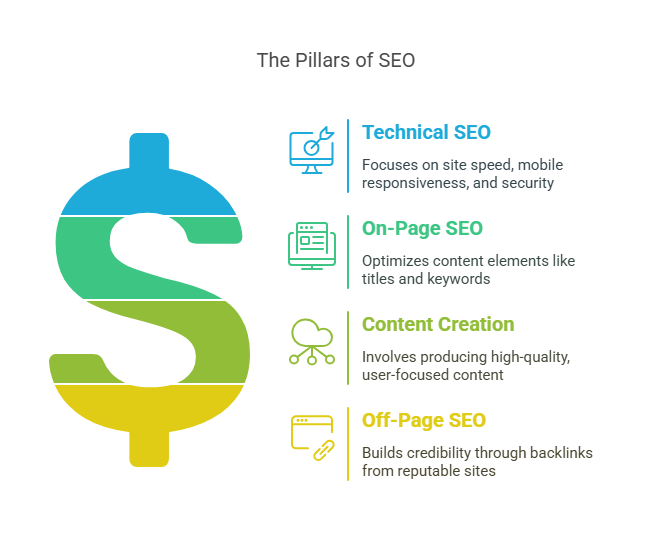
Core Pillars of SEO
- Technical SEO
Technical SEO addresses the behind-the-scenes elements that affect how search engines crawl, interpret, and index your site. This includes improving site speed, ensuring mobile responsiveness, maintaining secure HTTPS protocols, and fixing any crawl or indexation issues. If a search engine’s bots can’t properly crawl your site, no amount of on-page or off-page optimization will significantly help. - On-Page SEO
On-page SEO is all about optimizing what appears on your website’s individual pages. This means crafting clear title tags, meta descriptions, header tags (H1, H2, H3), and ensuring that the keywords you want to rank for are appropriately used. High-quality on-page optimization also includes ensuring a logical site structure and internal linking strategy that helps visitors and search engine bots navigate easily. - Content Creation
Content is the fuel that powers SEO. Publishing high-quality, user-focused content that answers key questions, meets intent, and delivers value is critical to ranking well. As you produce more authoritative articles, blog posts, product descriptions, or other content, search engines have more data about the relevance of your site. - Off-Page SEO
Off-page SEO primarily revolves around the backlinks your site earns from external websites. When reputable sites link to your content, search engines view your pages and brand as more credible. Building a healthy backlink profile can significantly influence your site’s rankings.
Why SEO Matters
SEO can be a slower burn compared to paid search, but once your site gains traction, the benefits often compound. High rankings lead to steady organic traffic, and if you maintain and update your content, that traffic can sustain (and grow) over time—without continuous ad spend. While algorithm updates can cause occasional shifts in rankings, a strong, well-rounded SEO strategy rooted in valuable content and user-friendly site architecture typically weathers these storms well.
The Long-Term Investment Perspective
One of the main advantages of SEO is its potential for compounding returns. Each new piece of optimized content that ranks well doesn’t just bring in immediate traffic; it also bolsters the overall authority of your domain. Over time, subsequent pieces of content tend to rank more easily, particularly if they’re connected through internal linking and relevant topics. This effect is similar to financial compounding, where the value of your initial “investment” in content creation and technical optimization grows exponentially over time.
2. What Is Paid Search?
Defining Paid Search
Paid search, also commonly known as Pay-Per-Click (PPC), involves paying for ad placements on search engines such as Google and Bing. Rather than waiting for organic rankings, businesses bid on keywords relevant to their products, services, or content. If they win the bid, their ads appear at the top (or bottom) of the SERPs. Every time a user clicks on one of these ads, the advertiser pays a certain amount—hence, pay-per-click.
Components of Paid Search
- Google Ads and Bing Ads
The most common platforms for paid search are Google Ads (which dominates the market) and Microsoft Bing Ads. While Google generally has the lion’s share of search traffic, Bing’s network can still be valuable, especially if you’re looking to expand beyond Google and reach additional demographics. - Keyword Bidding
Advertisers choose specific keywords they believe their target audience is likely to search for. These keywords can vary in cost, often determined by competition, industry, and user intent. High-intent, competitive keywords (e.g., “best credit card,” “emergency plumber in NYC”) can cost significantly more than broader or niche terms. - Landing Page Optimization
When users click on a paid ad, they’re directed to a landing page. This page must be highly relevant to the keyword and ad copy; otherwise, the campaign’s Quality Score (in Google Ads) can suffer, leading to higher costs and lower ad positions. Effective landing pages are optimized for conversions, with clear calls to action, persuasive copy, and user-friendly design. - Ad Copywriting and Campaign Analytics
Crafting compelling ads is essential in a crowded SERP. Marketers often test multiple variations of headlines, descriptions, and calls to action to maximize click-through and conversion rates. Once ads are running, it’s crucial to track key metrics—like cost per click (CPC), click-through rate (CTR), cost per acquisition (CPA), and return on ad spend (ROAS)—to refine campaigns over time.
Speed and Control
The biggest advantage of paid search is its immediacy. You can set up a campaign in the morning and see results by afternoon. This speed is invaluable for seasonal promotions, product launches, or quick audience tests. Furthermore, paid search offers granular control over your target audience—by location, device type, time of day, even demographics—giving you the power to refine your approach meticulously.
Cost Considerations
The main drawback is the ongoing cost. Once you stop paying, your ads disappear and so does your traffic. Additionally, competitive keywords can be prohibitively expensive, especially for smaller businesses. It’s not uncommon to see CPCs higher than $50 in industries like law, finance, and insurance. In such cases, a poorly managed PPC campaign can quickly drain budgets without delivering substantial returns.
3. SEO vs. Paid Search: A Side-by-Side Comparison
To truly understand the value each channel can provide, it’s helpful to look at their major points of differentiation. Below is an expanded look at six critical factors for any marketer or business owner to consider:
1. Cost
- SEO: While there’s no direct “per-click” cost, SEO typically requires an upfront investment in site improvements, content creation, and link building. If done in-house, there’s a cost in man-hours and specialized tools. If outsourced, agencies or consultants typically charge monthly retainers or project-based fees. Over time, the cost per acquisition (CPA) tends to decrease because well-ranked pages can keep bringing in traffic without additional ad spend.
- Paid Search: The immediate cost per click can be high, especially in competitive niches. The more you spend, the more traffic you can drive—up to a point. However, the moment you cut your budget, the traffic dissipates. Paid search is straightforward in terms of budgeting: set a maximum daily or monthly spend, and let the platform do the rest.
2. Time to Results
- SEO: Patience is a virtue here. It can take months—sometimes six months or more—to see significant ranking improvements, especially if you’re in a competitive field.
- Paid Search: Results are almost instant. Launch a campaign and you can start seeing clicks, leads, or sales within hours.
3. Sustainability
- SEO: Once a page secures a high-ranking position, it can remain there for weeks, months, or even years, generating organic traffic indefinitely (provided you keep your content updated and relevant).
- Paid Search: Visibility is tied directly to budget. Turn off the ads or run out of funds, and your presence on the SERPs is gone.
4. Trust and Click-Through Rates
- SEO: Users often perceive organic results as more trustworthy and credible. Studies have frequently shown that the top organic positions garner a substantial portion of clicks compared to paid ads, particularly among users savvy to online advertising.
- Paid Search: Some users will click on ads, but there can be a degree of skepticism or “ad blindness.” That said, mobile users often click on ads—especially if they’re in a hurry or if the ads are well-tailored to their query.
5. Targeting Options
- SEO: You can’t directly control who sees your organic listings—your main levers are content and keyword optimization. Your results depend on meeting specific queries and intent.
- Paid Search: Extremely granular targeting is possible, allowing you to show ads by geography, time of day, device, gender, age bracket, and more (depending on the platform). This granularity is a major win for businesses aiming to control their funnels precisely.
6. ROI Timeline
- SEO: Over a 12–24 month horizon, SEO can deliver an exceptional return on investment. Because traffic is “free” once you’re ranking, each additional visitor further lowers overall acquisition costs.
- Paid Search: Paid search can deliver a strong ROI quickly, but it tends to be less cost-efficient if extended indefinitely, especially in high-cost industries.

4. The Benefits of SEO
1. Sustainable Organic Traffic
One of SEO’s greatest strengths is its ability to generate consistent, long-term traffic once your pages rank well. This can be especially powerful for evergreen topics or high-intent commercial keywords. Rather than paying per click, you essentially earn those clicks by proving your site’s relevance and authority to search engines.
2. Builds Authority and Credibility
When your website appears at the top of organic search results, it carries an air of credibility in the eyes of many users. People often assume that if Google ranks you highly, you must be a reliable source of information or a reputable business. This trust factor can significantly boost conversions, brand recognition, and customer loyalty.
3. Higher Click-Through Rates (Especially Over Time)
Organic listings often see higher overall CTRs compared to paid ads for many queries. While the top ad might catch the eye of some, many users (particularly those who do research extensively) may skip straight to the top organic listings, believing them to be more objective. Over time, this preference can drive a substantial share of traffic your way.
4. Cost-Efficiency Over Time
Although SEO can be expensive initially—whether through outsourced services or the cost of building and maintaining an in-house team—successful campaigns often see the cost per acquisition drop significantly as more pages rank. This can lead to better margins and a stable traffic source that doesn’t rely on continuous ad spend.
5. Compounding Returns
Quality SEO has a flywheel effect. The more high-value content you publish, the more backlinks and social shares it can attract. Each piece of content contributes to building domain authority, which then makes it easier to rank future pieces of content. As the process repeats, the cumulative traffic and brand visibility can grow exponentially.
5. The Drawbacks of SEO
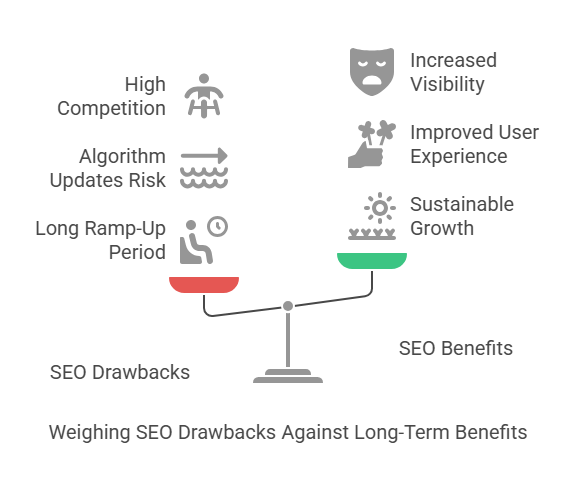
1. Long Ramp-Up Period
Perhaps the most cited drawback, SEO can take a substantial amount of time to bear fruit—often 3–6 months or more, depending on your industry’s competitiveness. For businesses needing immediate leads and sales, this can be a major deterrent.
2. Google Algorithm Updates
While a solid, white-hat SEO strategy usually weathers most algorithm changes well, there is always an element of uncertainty. Google, Bing, and other search engines regularly update their algorithms to improve user experience or weed out spammy practices. These updates can sometimes cause significant ranking fluctuations, even for websites adhering to best practices.
3. High Competition
In highly competitive sectors—legal, finance, real estate, and so on—ranking on the first page can be a daunting task. It may require a sizable content marketing budget, sustained link-building efforts, and high-level technical proficiency. New or smaller players might find it challenging to compete against established domains that have been around and building authority for years.
4. Ongoing Maintenance
SEO is not a one-and-done deal. Ongoing efforts are needed to maintain and improve rankings. This could include updating existing content, addressing technical issues (broken links, slow pages, etc.), earning new backlinks, and keeping an eye on competitors who are also vying for the same SERP real estate.
6. The Benefits of Paid Search
1. Fast Results
The speed at which paid search campaigns can be deployed and deliver results is unmatched. If you have a new product, a limited-time promotion, or simply want to test the waters, PPC enables you to get in front of potential customers almost immediately.
2. Precise Targeting
With paid search, you can segment your audience by location, device, time of day, language, and even past interactions with your website (via remarketing). This granularity can significantly improve your return on ad spend (ROAS) by funneling your budget exactly where it’s most likely to yield results.
3. Full Funnel Control
Because you can create dedicated landing pages for specific ad groups or campaigns, you have the opportunity to control the user experience from the moment they see your ad until they (hopefully) convert. Optimizing landing pages for targeted keywords and audience segments can dramatically boost conversions.
4. Easy Testing and Optimization
Paid search platforms make it straightforward to run A/B tests on headlines, descriptions, and landing pages. If a particular ad variation underperforms, you can pause it or revise it quickly. Data is readily available in real-time, so you can make swift changes to improve results.
7. The Drawbacks of Paid Search
1. Costs Can Add Up Fast
PPC can be notoriously expensive if not managed carefully. Competitive keywords can range in cost from a few dollars per click to well over $100, depending on the industry. Without rigorous tracking and optimization, a campaign can drain budgets quickly, especially if conversions aren’t adequately tracked or landing pages aren’t optimized.
2. Short-Term Visibility
Paid search is a pay-to-play model. Once the budget is cut off or depleted, your ads disappear, and so does your traffic. Unlike SEO, there’s no residual benefit or long-term accrual of authority. If long-term brand presence is your main goal, relying solely on paid search can be a vulnerability.
3. Ad Fatigue
Users can become “ad-blind,” particularly if they see the same ads repeatedly. This is especially true for remarketing campaigns that follow users around the web. Overexposure can lead to diminishing returns over time, necessitating frequent changes in ad creative or targeting strategies.
4. Lower Trust
Despite improvements in how ads are displayed, many users still scroll past ads to reach organic results, viewing the latter as more unbiased or trustworthy. If you rely solely on paid ads, you might miss out on those potential customers who prefer to click on organic listings.
8. Use Cases: When to Choose SEO or Paid Search
Every business has unique needs, budgets, and timelines. While SEO and paid search often work best when used in tandem, there are clear scenarios where one might be more suitable than the other.
Choose SEO When:
- Long-Term Growth: If you’re focused on building enduring brand visibility and authority, SEO is the ideal choice. Over time, you can become a go-to resource in your niche without continuously paying for clicks.
- Brand Authority: If you want your brand to be recognized as a thought leader or subject matter expert, creating in-depth, authoritative content that ranks organically can cement that reputation.
- Lower Competition or Local Niches: For niche markets or local businesses where competition may be less intense, ranking on page one might be more achievable and maintainable with consistent effort.
- Time and Resources: If you have a runway of several months before needing significant traffic, investing in SEO can pay dividends.
Choose Paid Search When:
- Immediate Leads: If your business needs a quick influx of traffic or sales—say for a new product launch—PPC is usually the fastest route.
- Short-Term Campaigns: Running a limited-time promotion or seasonal event? Paid search ensures you get in front of searchers during those peak windows.
- Granular Targeting: If your product or service caters to a very specific demographic or location, PPC’s targeting features can help minimize wasted ad spend.
- Generous Marketing Budget: If you have the funds to sustain a competitive PPC campaign, paid search can be a reliable source of leads and conversions as long as you manage it closely.

9. ROI Comparison: Long-Term vs. Short-Term Value
SEO ROI (Over 12–24 Months)
- Investment: Ranges from a few thousand to tens of thousands of dollars, depending on the scale and competitiveness of your niche. This often includes the cost of content creation, technical audits, link-building campaigns, and ongoing optimizations.
- Ongoing Costs: Even after initial investments, expect monthly or quarterly expenses for maintaining and updating your site, but these are usually less than the up-front outlay.
- Return on Investment: In many studies, SEO yields high returns—some estimates put it at 5.5x or more, meaning that for every dollar spent, you might see $5.50 in revenue (or even higher in some cases). As your content ages and you accrue domain authority, your acquisition costs can continue to drop, boosting ROI further.
Paid Search ROI (Over 3–6 Months)
- Investment: Highly variable and directly tied to clicks. A monthly spend can be as low as $1,000 for small campaigns or well over $50,000 for larger, more aggressive campaigns.
- Return on Ad Spend (ROAS): Short-term ROI can be very strong, particularly if you optimize carefully and pick high-converting keywords. However, sustainability becomes challenging if CPCs are high and margins are tight.
- Variability: ROI in paid search can fluctuate widely based on competition, keyword selection, landing page experience, and even external factors like seasonality or economic conditions.
10. Real-World Case Studies
Seeing theoretical benefits is one thing; examining how real businesses leverage these strategies provides tangible insights.
Case Study 1: E-Commerce Brand
- Challenge: A mid-sized e-commerce store that specializes in seasonal clothing lines struggled with low brand awareness. They needed immediate sales during key seasonal launches but also wanted to build a stable foundation of year-round traffic.
- Solution: The company used paid search (Google Ads) to drive targeted traffic for new product lines during fall and winter launches. Simultaneously, they invested in SEO by creating evergreen blog content focused on fashion tips, seasonal trends, and style guides.
- Results:
- They experienced a 210% surge in traffic during product launches, attributable to well-optimized Google Ads campaigns.
- Year over year, their organic traffic grew by 47% as their SEO content began to rank for relevant fashion-related queries.
- Cost per customer acquisition decreased over 12 months, as organic traffic contributed an increasing share of total conversions.
Case Study 2: B2B SaaS Company
- Challenge: A B2B SaaS provider operating in the project management space faced extremely high CPCs for core keywords like “project management software” or “team collaboration tools.”
- Solution: They began using PPC selectively to test user intent and identify the highest-converting keywords. Then they channeled those insights into developing robust content hubs, addressing specific pain points uncovered by paid campaigns.
- Results:
- They managed to cut their PPC budget by 38% after refining their keyword list and focusing on their top-performing terms.
- Organic traffic generated a 65% increase in demo sign-ups within a year, fueled by the newly created content hubs.
- Lead quality improved overall, with a notable rise in customers who discovered the brand via both organic and paid channels, suggesting synergy between the two.
11. How to Use SEO and Paid Search Together
Many marketing experts agree that an integrated approach to SEO and paid search can yield the best results. When properly combined, the two channels can amplify each other.
1. Use Paid Search to Test Keywords
Instead of guessing which keywords will resonate best, you can use PPC to quickly gather data on click-through rates, conversion rates, and the profitability of certain search terms. Once you identify the most lucrative keywords, you can double down on SEO for those terms, creating high-quality content designed to rank organically.
2. Own the SERP
Appearing in both paid and organic listings can give an impression of dominance and credibility. Users might see your ad first and then notice your organic listing just below. This dual presence can enhance brand recognition, sometimes leading to higher click-through rates on both placements.
3. Retarget Organic Visitors with PPC
Not every user who arrives organically will convert on the first visit. By setting up remarketing campaigns, you can serve targeted ads to visitors who have already engaged with your content. This tactic can gently remind prospects about your offerings, leading them back to your site for a second look.
4. Share Data Between Teams
Encourage collaboration between your SEO and PPC teams. Insights from PPC—like high-performing ad copy, user demographics, or negative keywords—can be used to refine SEO meta descriptions, content angles, and overall site structure. Conversely, popular SEO content can be promoted through paid channels to boost visibility and test if certain topics also resonate in a paid context.
12. Which Strategy Is Right for You?
Determining which strategy—or mix of strategies—is right for your business depends on a few key questions:
- Are you seeking immediate traffic or can you wait for a ramp-up?
- If your business needs leads ASAP, paid search is the go-to.
- If you have a longer horizon to establish a sustainable presence, SEO might be more worthwhile.
- Is your budget sufficient to handle high CPCs if your industry is competitive?
- If you’re tight on funds, focusing solely on paid search could quickly deplete your resources.
- SEO, while requiring an up-front investment, can be more cost-effective in the long run.
- What are your overarching marketing and brand goals?
- If brand authority, thought leadership, and enduring visibility are paramount, SEO is hard to beat.
- For short-term campaigns or promotional offers, it’s usually paid search.
- Do you have resources for ongoing content creation and website maintenance?
- SEO success hinges on fresh, high-quality content and technical upkeep. If you lack the bandwidth, your results may stagnate.
- Paid search requires regular monitoring but can be more “plug-and-play” if you have a skilled PPC manager or agency.
Often, the ideal scenario involves combining both. You use PPC to kickstart immediate sales and gather valuable data, while simultaneously building an SEO foundation that will yield steady, low-cost traffic in the future.
13. Final Takeaways
SEO as a Long-Term Powerhouse
- Consistency Wins: SEO is not about quick fixes. It’s about steadily building a presence through technically sound optimizations, user-centric content, and authority-building backlinks.
- Algorithm-Resistant Strategies: By focusing on user experience, high-value content, and ethical link-building, you remain relatively insulated from major ranking disruptions.
Paid Search as an Immediate Catalyst
- Rapid Results: Few marketing channels can compete with PPC in terms of how quickly it can generate traffic and leads.
- Precise Targeting: The ability to serve customized messages to different audience segments is a massive advantage.
Balancing Both
- Data Sharing: Paid search can guide your SEO keyword strategy, while SEO insights can help refine your paid campaigns.
- Holistic Visibility: Securing both paid and organic spots can amplify your brand’s impact on the SERPs.
Key Pitfalls to Avoid
- Neglecting One Channel Entirely: Ignoring SEO means missing out on long-term benefits; ignoring paid search could mean leaving immediate revenue on the table.
- Lack of Tracking and Measurement: Whichever route you choose, implement robust analytics. If you don’t track conversions, ROI, or user behavior, you’re essentially flying blind.
In 2025 and beyond, digital marketing is all about diversification and adaptability. SEO and paid search each have unique advantages, but they can also complement each other in powerful ways. The true “winner” is the marketer who knows how to harness both effectively.
14. Next Steps
So, how do you move forward? Below is a strategic outline that can help businesses and marketers of all sizes plan an integrated approach.
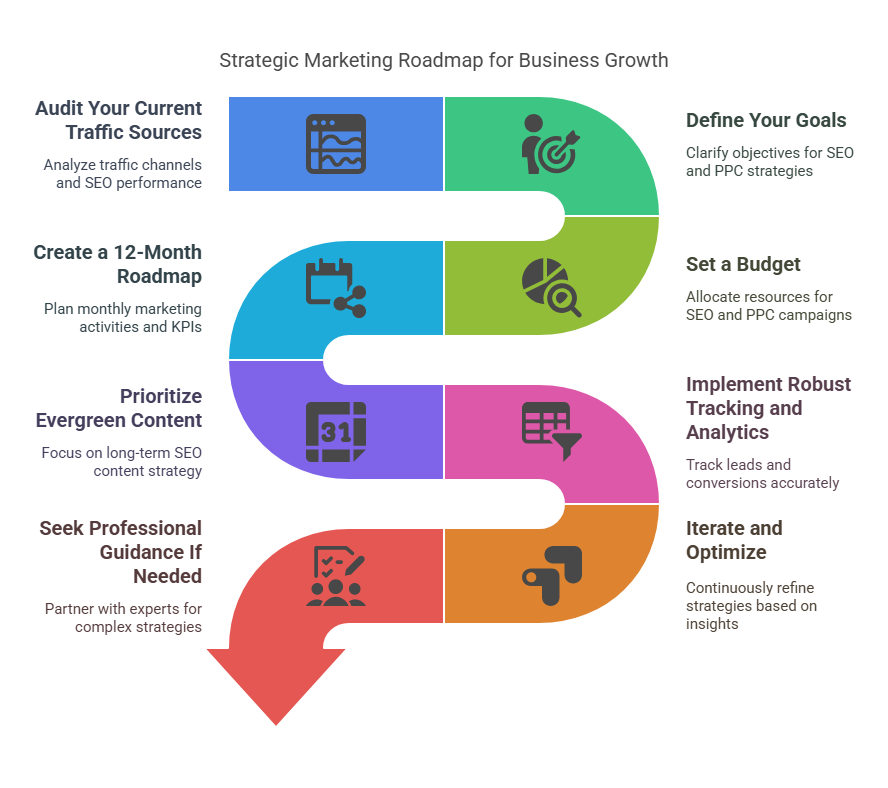
- Audit Your Current Traffic Sources
Take a close look at your analytics to see where your current visitors are coming from. Are you heavily reliant on one channel? Are there opportunities to diversify? Conduct a thorough SEO audit to identify technical issues, content gaps, and backlink quality. Simultaneously, review any active PPC campaigns to evaluate their cost-effectiveness. - Define Your Goals
Are you seeking to build brand awareness, increase conversions, or test new products? Clarifying your objectives will help determine the ideal mix of SEO and PPC. For instance, if brand awareness is key, focusing on informational keywords via SEO can position your site as a go-to resource. If conversions on a specific product page are your immediate priority, paid ads targeting high-intent keywords might be the best bet. - Set a Budget
Allocate your marketing budget in a way that aligns with your objectives and timelines. Some businesses might prefer a 60/40 split in favor of SEO, given its long-term payoff. Others may go 70/30 towards PPC if immediate growth is essential. The key is to remain flexible and adjust as you glean insights. - Create a 12-Month Roadmap
Lay out a month-by-month plan detailing when you’ll launch or optimize PPC campaigns, which SEO content pieces you’ll create, and key performance indicators (KPIs) for each. By charting your course ahead of time, you can track progress more effectively and avoid reactive marketing decisions. - Prioritize Evergreen Content
For SEO, prioritize evergreen topics that remain relevant to your audience year-round. These posts often become consistent traffic drivers. Simultaneously, develop dynamic content that can be seasonally or event-focused, which can be supported through PPC during peak periods. - Implement Robust Tracking and Analytics
Whether you use Google Analytics 4 (GA4), another analytics suite, or a combination of tools, ensure you can accurately track where your leads and conversions originate. Without this data, optimizing both SEO and PPC strategies is guesswork. - Iterate and Optimize
Digital marketing is an ongoing cycle of planning, execution, measurement, and refinement. Test new ad copies, new keywords, new content formats, and promotional angles. Use insights from each experiment to inform the next set of actions. - Seek Professional Guidance If Needed
If you find the intricacies of SEO or the complexity of PPC platforms overwhelming, consider partnering with an experienced agency or consultant. They can help you navigate competitive industries, manage large ad budgets responsibly, and stay current with ever-shifting best practices.
Ready to Build Your Strategy?
If you’re poised to combine the long-haul benefits of SEO with the immediate impact of paid search, the most critical step is action. Even small tests—like running a limited PPC campaign or optimizing a handful of key SEO pages—can yield valuable insights. Don’t fall into the trap of analysis paralysis; a well-measured approach with continual refinements often outperforms extensive planning that never makes it into the real world.
Final Thoughts
In the evolving digital landscape of 2025, the question “SEO vs. Paid Search: Which strategy reigns supreme?” doesn’t have a simple, one-size-fits-all answer. Both channels offer distinct advantages, and each has potential pitfalls. For businesses that can afford it, an integrated approach leveraging both SEO and paid search is often the most effective path to achieving comprehensive, sustainable growth. SEO builds long-term brand authority, cultivates trust, and eventually drives cost-effective organic traffic. Paid search serves as the quick, precise, and agile counterpart that can jumpstart sales, validate new ideas, and keep revenue flowing during the SEO ramp-up period.
At the heart of this debate is the recognition that modern consumers are multifaceted. They don’t always choose to click on the first ad, nor do they exclusively stick to organic results. By strategically occupying both spaces, brands stand a better chance of engaging potential customers along multiple touchpoints—raising awareness, nurturing interest, and facilitating conversions. As we progress further into the 2020s, data-driven marketing that marries the strengths of SEO and PPC will likely be the hallmark of leading digital strategies.
If you’re ready to move forward, start by auditing your current efforts and setting clear objectives. Then decide how to allocate resources based on time, budget, and market competition. Perhaps most importantly, remain adaptable. Search engines evolve, consumer behaviors shift, and new technologies emerge. The businesses and marketers who remain vigilant, measure performance meticulously, and pivot intelligently will be the ones to thrive, regardless of which side of the SEO vs. Paid Search debate currently seems to “win.”
Whatever mix of strategies you choose, keep your audience’s needs front and center. Deliver value through content, solve user problems, and ensure a seamless browsing experience—those principles remain the bedrock of online success. By combining the long-term resilience of SEO with the instant impact and precise targeting of paid search, you can craft a marketing plan that stands strong in the face of changing algorithms, rising competition, and evolving consumer preferences.

- Podcast: Beginners SEO with Phoebe, The Plan Success
- Podcast: SEO in 2025 with David Bain
- Are you looking for help building your SEO? Try check out the Marketplace here on SparkUpBiz!
