

Online engagement has become a cornerstone of success for businesses, content creators, and communities of all sizes. In an era dominated by social media, digital marketing, and constant connectivity, the ability to keep your audience interested, involved, and coming back for more is crucial. The ways we engage our followers may vary—from text-based content, videos, images, live streams, to interactive elements such as polls and surveys. However, one key element often remains consistent: the power of dialogue. When you enable your audience to participate in a conversation, you foster a sense of belonging and investment.
This article focuses on one of the most impactful but sometimes underutilized engagement tools: online polls and surveys. They offer a perfect blend of simplicity and depth to increase engagement. Polls can provide immediate snapshots of audience opinion, while surveys can dig deeper to uncover insights that might otherwise remain hidden. Whether you’re a small business aiming to understand consumer preferences, a social media influencer seeking audience feedback, or a large corporation trying to stay in touch with market trends, polls and surveys can serve as a vital feedback loop.
Yet, creating an effective poll or survey is more than just writing a question and posting it. Strategy, clarity, timing, and analysis all play critical roles in reaping meaningful benefits. Throughout this comprehensive guide, we’ll explore the “why” and “how” behind creating polls and surveys that resonate with your audience. You’ll learn how to design them for maximum impact, deploy them across the right platforms, analyze your results effectively, and ensure that you maintain ethical standards along the way to skyrocket engagement.
While we’ll explore the theories of engagement and psychology, we’ll also provide concrete examples, tips, and best practices to help you turn ideas into real-world action. By the end, you’ll not only understand the importance of online polls and surveys to increase engagement, but you’ll also have a roadmap for using them to boost engagement, foster loyalty, and achieve your broader goals in the digital space.
Let’s begin by examining the overall importance of engagement—why it matters, how it impacts growth, and why polls and surveys are among the most effective tools in your arsenal for fostering sustained interaction in an increasingly busy online world.
The Importance of Engagement in the Digital Landscape
Before diving deeper into the specific role that polls and surveys play in increasing engagement, it’s helpful to take a step back and consider why engagement is so important. We live in a fast-paced digital landscape where every brand, content creator, or organization competes for attention. Scroll through any social media platform, and you’ll see a perpetual stream of content—text posts, videos, photos, live broadcasts—an endless scroll that competes for an individual’s limited time. In this environment, capturing and holding attention is the name of the game.
Engagement vs. Awareness
A common mistake is to focus exclusively on awareness—i.e., reaching as many eyes as possible. While awareness is vital (after all, people can’t engage with what they don’t see), engagement is what solidifies connections. People may become aware of your brand or message, but if they don’t interact—through likes, comments, shares, or poll responses—they’re not actively participating in a conversation with you. Research has shown that active participation leads to deeper memory encoding and a stronger emotional bond with the content or brand. Essentially, the more someone interacts with you, the more likely they are to remember you, trust you, and become a loyal audience member or customer.
Community Building and Loyalty
Engagement is also the backbone of community building. When people feel like they have a voice and that their voice matters, it fosters a sense of belonging. Polls and surveys, by their very nature, invite that voice. They say, “We want to hear from you.” This is a powerful message in a world that can sometimes feel dominated by one-way communication. Frequent engagement fosters relationships and loyalty. A loyal community will not only buy your products or consume your content, but they will also become brand ambassadors, sharing and recommending you to their friends, family, and colleagues.
Influence on Social Media Algorithms
Every major social media platform—whether it’s Facebook, Instagram, Twitter (now X), LinkedIn, or TikTok—operates on an algorithmic feed. These algorithms prioritize content that is likely to generate higher engagement. The logic is simple: the more people interact with a post, the more valuable or interesting it is perceived to be, and thus the platform showcases it to a wider audience. This is where polls and surveys shine. They naturally spark interaction because voting or responding requires minimal effort but still counts as an engagement signal.
Data-Driven Decision Making
Finally, engagement provides data. When people comment, share, or vote in a poll, they are sharing their preferences, opinions, and behaviors. This data, when interpreted correctly, can inform your business, content strategy, product development, or service improvements. Instead of guessing what your audience wants, you can simply ask them. That saves time, resources, and helps you stay aligned with your audience’s evolving needs.
In summary, engagement is more than just a number. It’s the difference between a passive audience that occasionally sees your message and an active community that feels connected and invested. And among the myriad tools available to generate engagement, polls and surveys stand out as some of the most efficient and effective. In the next section, we’ll explore the psychology behind why these tools resonate so deeply with audiences.

Why Polls and Surveys Work to increase engagement: The Psychology of Participation
Polls and surveys are not just random question-and-answer sessions; they tap into fundamental aspects of human psychology. Understanding these psychological underpinnings can help you design questions that compel people to participate, resulting in richer engagement.
The Desire to Be Heard
One of the most basic human needs is the desire to be heard and acknowledged. When you post a poll or a survey, you are effectively saying, “Your opinion matters.” This can make people feel valued and more willing to engage. The effect is especially strong in online communities where individuals might sometimes feel overlooked among larger crowds. Providing a simple way to voice their thoughts—such as a quick poll—meets this fundamental need.
The Power of Minimal Effort
Polls and short surveys require very little effort compared to writing a full comment or creating content. This idea is sometimes referred to as the “foot-in-the-door” technique in psychology, which states that people are more likely to comply with a larger request if they first comply with a smaller one. Voting on a poll is a small action that opens the door for future engagements like comments, shares, or more in-depth surveys.
Social Proof and FOMO (Fear of Missing Out)
When people see others participating in a poll or survey, social proof kicks in. Humans naturally look to others for cues on how to behave. If many individuals have already voted or participated, new viewers might be encouraged to do the same. In addition, a sense of missing out can motivate people. If a poll or survey is framed in a way that suggests exclusivity—“Don’t miss your chance to shape the outcome!”—it can drive even more engagement.
Curiosity and Instant Gratification
Polls offer something that many forms of content do not: immediate feedback. People vote and, in some cases, see results instantly. This instantaneous reward loops back into that sense of gratification. The curiosity about what others think—“Am I in the majority or the minority?”—can be incredibly compelling. This curiosity gap is a powerful motivator for people to click that button or fill out that question.
Personal Relevance and Control
Finally, polls and surveys can make people feel like they have some control. When an organization or individual asks for feedback on a product, service, or future direction, it suggests that the participants’ opinions genuinely matter. Feeling a sense of control and influence over something—be it a community’s next content theme or a brand’s product line—enhances personal relevance. And with personal relevance comes a higher likelihood of engagement.
By keeping these psychological factors in mind, you can craft questions that not only collect data but also tap into deeper motivations. This leads to higher participation rates, more meaningful answers, and a sense of connection that participants carry with them after they’ve responded.

How Polls and Surveys Increase Engagement
Having touched on the broader context of engagement and the psychology behind polls and surveys, let’s talk about how these tools specifically drive interaction. The effectiveness of polls and surveys boils down to a few interconnected factors:
They Invite Easy Interaction
The simpler it is to engage, the more likely people are to do so. Polls reduce the friction of participation. Instead of composing a comment, a user can simply select an option with a click or tap. This removal of barriers encourages more users to take that small action. Over time, these small actions can add up to significant overall engagement.
They Provide Instant Value
Polls and short surveys can provide instant insights for both creators and participants. A user gets to see how their opinion compares with others. This sense of immediate gratification can help a post stand out in a sea of content that might otherwise be skimmed over. Instant value can also be self-reinforcing; if someone enjoys answering one poll, they’ll be more likely to answer again in the future.
They Generate Conversational Sparks
Polls often serve as conversation starters. After someone votes, they might head to the comments to elaborate on their choice, debate with others, or ask follow-up questions. This ripple effect of dialogue can significantly amplify your reach and create a more active thread. It’s not uncommon for a simple poll to lead to an extensive discussion on complex topics.
They Encourage Sharing
If a poll or survey is topical, funny, or aligns with a particular community interest, people are more likely to share it with friends or followers. Sharing can exponentially grow your reach, bringing in new participants who may not have been aware of your brand or community before. Additionally, people may share the results of a poll if they find them surprising, thus extending the conversation and further boosting engagement.
They Offer Valuable Insights
Beyond the immediate boost in engagement, polls and surveys offer the opportunity to gather insights that can inform future content, product development, and more. When people see that their participation leads to real outcomes (such as new product features or changes in content direction), they become more invested. Over time, this repeated loop of asking, listening, and acting on feedback builds trust and loyalty.
This cycle—ask, engage, analyze, act—is at the heart of how polls and surveys fuel ongoing engagement. Each step feeds into the next, creating a sustainable environment where feedback is constantly sought and used, and the audience’s voice shapes the community or brand direction.

A Deep Dive Into Different Types of Polls and Surveys to increase engagement
Not all polls and surveys are created equal. The type you choose should align with your broader goals. In this section, we’ll explore the various categories in more detail, giving you a richer understanding of when and how to use each.
Quick Engagement Polls
Definition and Purpose: Quick engagement polls are short, punchy, and often fun. They usually involve a single question with a handful of choices (or even just two options). The primary goal is to spark immediate interaction without requiring much effort from participants.
- Example Questions:
- “What’s your favorite morning beverage?”
- Options: Coffee, Tea, Smoothie, Other
- “Which of these TV shows should we binge-watch this weekend?”
- Options: A, B, C, D
- “What’s your favorite morning beverage?”
Use Cases:
- Social media stories (Instagram, Facebook, Snapchat)
- Community forum threads as an icebreaker
- Brand pages looking to create a quick touchpoint with followers
Advantages:
- Easy to create and participate
- High participation rates due to low effort required
- Great for lighthearted or fun topics
Potential Drawbacks:
- Limited data depth
- May not be taken as seriously by participants
Feedback Surveys help engagement
Definition and Purpose: Feedback surveys are designed to gain insights about products, services, or any area of your community’s experience. These can range from a few questions to more detailed inquiries.
- Example Questions:
- “How satisfied are you with our latest product update?”
- “Which topic would you like us to cover in our upcoming webinar?”
Use Cases:
- Post-purchase feedback for ecommerce customers
- After-event surveys for attendees at webinars or conferences
- Regular check-ins with your audience to gauge satisfaction or gather improvement ideas
Advantages:
- Provides actionable data for product or service improvements
- Helps identify pain points and areas for innovation
- Fosters a sense of collaboration between brand and community
Potential Drawbacks:
- Longer surveys can deter some participants
- Requires careful question design to avoid biased or vague feedback
Opinion Polls to grow engagement
Definition and Purpose: Opinion polls are used to gauge public sentiment on a wide range of topics, from social issues to brand preferences. These polls can be fun or serious, depending on the subject matter.
- Example Questions:
- “Do you believe remote work is the future?”
- “Which emerging social media platform do you think will dominate next year?”
Use Cases:
- Community groups discussing current events
- Brands wanting to align themselves with audience values
- Influencers gauging public sentiment for content creation
Advantages:
- Encourages participants to share perspectives
- Helps in understanding audience views on broader topics
- Can spark in-depth discussions
Potential Drawbacks:
- Sensitive topics may provoke controversy or heated debates
- Results may not always be accurate if the sample size or demographic is skewed
Quiz-Style Polls help increase engagement
Definition and Purpose: These are interactive polls that often have a “right” or “wrong” answer or provide some form of personalized outcome. They’re less about raw opinion gathering and more about engagement and entertainment.
- Example:
- “What type of traveler are you? Take our quiz to find out!”
- “Which marketing strategy suits your business best?”
Use Cases:
- Gaining viral traction on social media
- Educational content creators testing knowledge retention
- Brand awareness campaigns where gamification can increase interest
Advantages:
- Highly shareable due to the fun factor
- Encourages repeated interaction as users may re-take the quiz
- Can collect segmented data if integrated with marketing tools
Potential Drawbacks:
- May require more effort to create
- Risk of misleading participants if the quiz is not well-structured
By understanding these different types of polls and surveys, you can tailor your approach to your specific objectives—be it quick community engagement, deep consumer insight, public opinion gauging, or interactive fun.
Strategies for Crafting Effective Polls and Surveys to increase engagement
Now that we’ve established the importance and varieties of polls and surveys, how do we ensure that these tools are effective? Crafting a poll or survey that people want to respond to requires attention to detail, clarity, and an understanding of your audience.
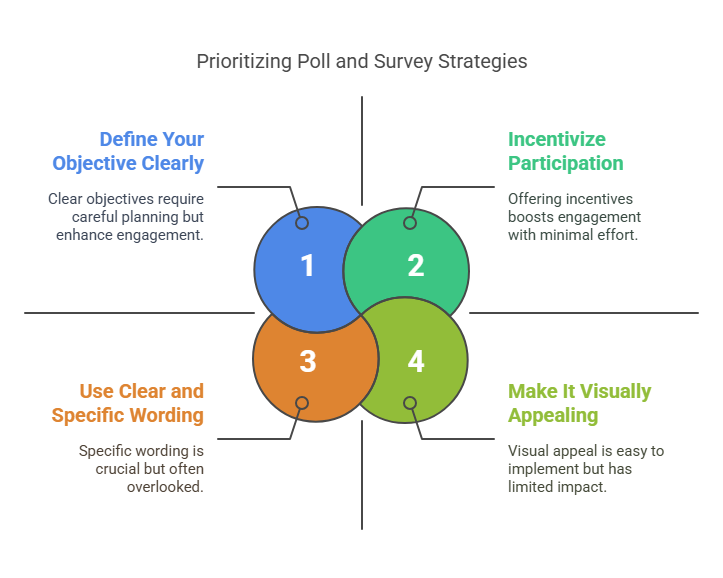
Define Your Objective Clearly
Every poll or survey should have a purpose. Are you trying to understand what your audience thinks about a new product idea? Are you simply looking for a fun way to spark a conversation? By defining your objective upfront, you can design questions that directly serve that goal. This clarity also helps your audience understand why they should participate.
Keep It Simple
When in doubt, simplify. A poll question buried in jargon or a survey with 50 questions will likely see lower participation rates. People have limited attention spans online, and confusion can easily deter them. Make sure your questions are concise, direct, and easy to read at a glance.
Use Clear and Specific Wording
Avoid ambiguity. If your question can be interpreted in multiple ways, your results will be muddy. For example, instead of asking, “Do you enjoy our new service?” you might ask, “On a scale of 1 to 5, how satisfied are you with our new streaming service’s video quality?” The latter question is more specific, guiding participants to focus on a particular aspect of the service.
Offer Balanced Response Options
Poorly designed polls sometimes use leading or biased choices. For example:
- “How much do you love our product?”
- Options: A) Very Much, B) Extremely Much, C) I’m Obsessed
This kind of poll might make participants feel forced into giving a positive answer. Ideally, provide a range of balanced options that allow for nuance. For instance:
- “Rate your experience with our new product”
- Options: 1) Very Unsatisfied, 2) Unsatisfied, 3) Neutral, 4) Satisfied, 5) Very Satisfied
Make It Visually Appealing
We live in a visual world. Whether you are posting a poll on Instagram Stories or embedding a survey on your website, use visuals to make it stand out. This could include relevant images, brand-consistent color schemes, or eye-catching typography. Just be sure not to overdo it to the point that your questions become hard to read.
Incentivize Participation (When Appropriate)
Providing a small incentive can significantly boost response rates. This could be anything from a discount code, a chance to win a giveaway, or access to exclusive content. However, ensure that the incentive doesn’t bias your results—some participants might just rush through the questions to get the reward.
Mind the Timing
Timing can make or break a poll or survey. Consider your audience’s online behavior patterns. Posting a poll in the middle of the night might yield fewer responses than during peak engagement hours. If you’re running a survey, give people enough time to respond but not so much that they lose interest.
Provide Context
Whenever possible, explain why you’re asking a particular question. A brief description—“Help us improve our upcoming features by answering this poll!”—can give participants a sense of purpose. This context can increase the perceived importance of responding, ultimately boosting your engagement.
When you blend these strategies—clear objectives, simplicity, balanced response options, visual appeal, incentives, optimal timing, and context—you create polls and surveys that are not only more likely to garner responses but also yield more accurate and actionable data.
Choosing the Right Platforms and Tools to increase engagement
Selecting the right platform for your poll or survey is a critical decision that can significantly affect participation rates and the quality of data. Different platforms cater to different audiences and offer varying degrees of customization and engagement features.
Website or Blog Surveys
Platforms: Embedded forms (e.g., using WordPress plugins), pop-up surveys, or custom-coded polls
Best For: More in-depth questions that require a captive audience, brand consistency, longer-form surveys
- WordPress Plugins (e.g., WPForms, Gravity Forms): Easy to set up, can embed in blog posts or site sidebars.
- Pop-up or Slide-in Surveys: Tools like Hotjar or Qualaroo can display a quick survey to users before they leave the page or after a certain time interval.
- Custom-Coded Solutions: Offers maximum flexibility and can be integrated seamlessly into your user experience, but typically requires development resources.
Dedicated Survey Platforms
Platforms: Google Forms, Typeform, SurveyMonkey, JotForm
Best For: Detailed surveys, data analytics, broad distribution, brand customizability
- Google Forms: Easy to use, integrates well with Google Sheets for data analysis, free for most users. Simple but effective features.
- Typeform: Known for its visually appealing, conversational interface that encourages higher completion rates. Offers advanced design options and integrations.
- SurveyMonkey: Robust platform with numerous question types, analytics tools, and audience panel options. Often used by businesses for customer or market research.
- JotForm: Offers drag-and-drop form creation and a range of templates and integrations with CRM and email marketing tools.
Live Streams and Webinars
Platforms: Zoom, YouTube Live, Facebook Live, Twitch
Best For: Real-time engagement, interactive events, immediate feedback
- You can deploy in-built polling features (e.g., Zoom Polls) or use external tools that integrate with your streaming platform.
- Ideal for audience members who are already highly engaged—asking poll questions mid-webinar can keep them attentive and provide instant insights.
Messaging Apps and Chatbots
Platforms: WhatsApp, Telegram, Facebook Messenger, Slack channels
Best For: Niche or private communities, direct communication, quick feedback
- Some communities prefer the intimacy and immediacy of messaging apps. Polls can be shared in group chats or via chatbot interactions.
- Particularly useful for internal team surveys or feedback within a closed group.
When choosing a platform, consider your target audience’s demographic, the length and complexity of the poll or survey, and your desired data analysis capabilities. In many cases, a multi-platform approach can be beneficial—quick polls on social media to attract attention and deeper surveys on a dedicated platform for more thorough insights.
Techniques for Analyzing and Interpreting Results to Increase engagement
Collecting responses is only half the battle. The real value emerges when you analyze those responses to glean insights that drive action. Proper analysis can guide your future content strategies, product roadmaps, or community initiatives.
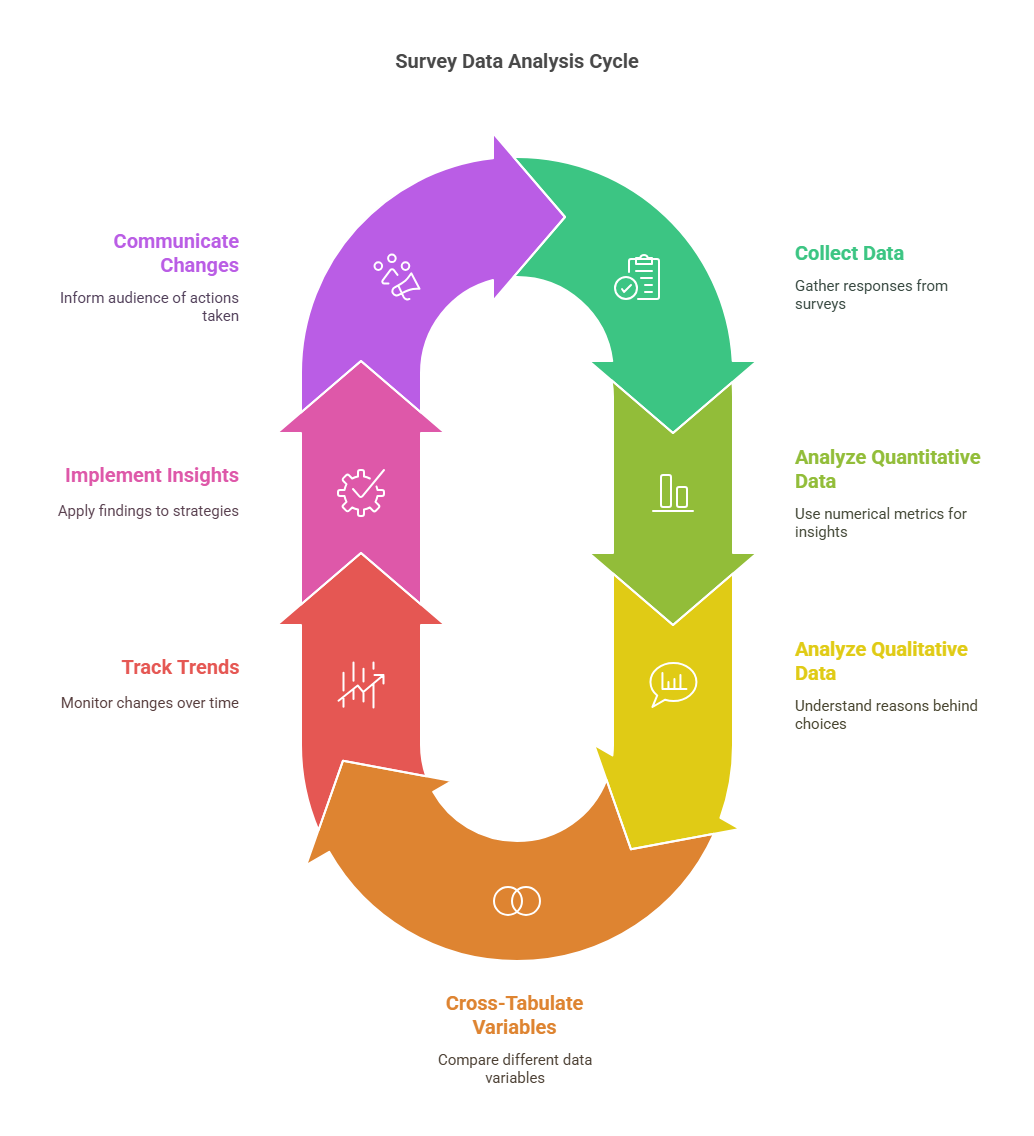
Quantitative Analysis
Definition and Purpose: Quantitative data includes numerical metrics—like the percentage of respondents who chose a specific option or the average score on a satisfaction scale.
- Tools: Spreadsheet software (Excel, Google Sheets), or built-in analytics in SurveyMonkey, Typeform, etc.
- Methods: Basic descriptive statistics (means, medians, modes) or more advanced analyses (regressions, correlations).
Example: If you asked, “How satisfied are you on a scale of 1 to 5?” and the average score is 4.2, it indicates a generally positive sentiment. However, also note the distribution—if the majority gave a 5 while a smaller group gave a 1, you may have two polarized subgroups.
Qualitative Analysis
Definition and Purpose: Qualitative data comes from open-ended responses. This type of analysis helps you understand the why behind people’s choices.
- Tools: Manual coding, text analysis tools like NVivo or Atlas.ti, or built-in features in some survey platforms.
- Methods: Identify recurring themes or sentiments. Group similar answers together to see which themes appear most frequently.
Example: If participants consistently mention “customer service” as a pain point in open-ended feedback, you know exactly where to focus improvements.
Cross-Tabulation
Definition and Purpose: Cross-tabulation involves comparing different variables within your data set to uncover relationships. For instance, how do preferences differ by age group, location, or user type?
- Tools: Spreadsheet pivot tables, advanced statistical software (SPSS, R, etc.).
- Methods: Look for patterns or significant differences across different demographics or user segments.
Example: Maybe your poll about preferred social media platforms reveals that younger participants favor Instagram, while older ones prefer Facebook. This insight could shape your marketing strategy.
Tracking Trends Over Time
Definition and Purpose: Conducting the same or similar polls periodically allows you to track changes in sentiment or behavior over time.
- Tools: Version-controlled spreadsheets, recurring surveys with time stamps.
- Methods: Compare responses from different time periods (monthly, quarterly, annually) to spot trends or shifts.
Example: A brand might run an annual customer satisfaction survey. If satisfaction scores increase each year, that’s a sign of effective improvements. If they drop, it’s an early warning signal to take corrective measures.
Putting Insights Into Action
Data without action is meaningless. Once you’ve identified key findings, the next step is to devise a plan for implementation.
- Example: If 70% of respondents express a desire for more video content, your editorial calendar might include weekly videos or live streams.
- Feedback Loop: Let your audience know that you heard them. Publish a summary of survey results or mention in your next post, “Based on your feedback, we’re introducing this new feature…”
By investing time in proper analysis, you turn raw poll or survey data into valuable intelligence. This not only improves decision-making but also validates to your audience that their input genuinely matters, creating a virtuous cycle of engagement and trust.
Practical Examples and Case Studies
To illustrate the concepts discussed, let’s look at a few hypothetical examples and mini case studies that demonstrate the power of polls and surveys in real-world scenarios.
Small E-commerce Business Seeking Product Feedback
Scenario: A small online shop specializes in handmade jewelry. They plan to launch a new line and want to know if their loyal customers prefer gold, silver, or mixed metal designs.
- Platform and Approach:
- A quick poll on Instagram Stories with three options: Gold, Silver, Mixed Metals.
- A short SurveyMonkey questionnaire emailed to their mailing list with images of the design prototypes.
- Outcome:
- The Instagram Story poll gets immediate engagement with several hundred votes, showing a preference for gold designs.
- The SurveyMonkey results indicate that while gold is most preferred, a smaller but significant segment enjoys the mixed metal look.
- Action:
- The business decides to produce both gold and mixed metal lines in smaller batches.
- They follow up with a post or email thanking participants and showing how the final pieces reflect their feedback.
Influencer Running a YouTube Channel
Scenario: A tech influencer wants to decide which topic to cover next: a review of a new smartphone, a tutorial on video editing, or a gaming laptop comparison.
- Platform and Approach:
- Runs a poll on the YouTube Community tab asking, “What video should I make next?” with the three options.
- Shares the same poll on Twitter (X) and Instagram Stories for more data points.
- Outcome:
- Smartphone review wins on YouTube, but the gaming laptop comparison is a close second on Twitter.
- Action:
- The influencer decides to produce the smartphone review first to satisfy the largest group, but also schedules a gaming laptop comparison for a later date, acknowledging the other segment’s interest.
- This approach ensures that all parts of the audience feel heard.
Local Community Organization
Scenario: A neighborhood association wants to plan a weekend event and is uncertain whether residents prefer a food festival, a craft fair, or a small concert.
- Platform and Approach:
- Sends out a Google Forms survey via email to the neighborhood mailing list, including descriptions and estimated costs for each event type.
- Posts a shorter version as a poll in the community’s Facebook group.
- Outcome:
- The craft fair emerges as the top choice in both the email survey and Facebook poll, with strong open-ended feedback supporting local artisans.
- Action:
- The organization plans a craft fair, invites local artists, and uses the survey data to plan relevant side activities (like children’s workshops).
- Post-event, they conduct a follow-up survey to gauge satisfaction and gather ideas for next year’s fair.
A Digital Marketing Agency
Scenario: A marketing agency wants to position itself as a thought leader. They decide to run a comprehensive survey on industry trends, gather the data, and publish a whitepaper.
- Platform and Approach:
- Creates a detailed Typeform with questions on budgets, platform usage, ROI metrics, and future predictions.
- Promotes the survey on LinkedIn, professional forums, and through email lists.
- Outcome:
- Collects responses from several hundred marketing professionals, gleaning insights on emerging platforms and budget allocations.
- Action:
- The agency compiles the findings into a whitepaper, credited to all participants as “2023 State of Digital Marketing.”
- They share this report freely, establishing credibility and attracting new leads who find the data useful.
These examples highlight how online polls and surveys serve different purposes—from quick decision-making to in-depth market research. In each case, the organizations or individuals benefit from clearer direction, stronger community ties, and actionable insights.
Common Mistakes and How to Avoid Them
Even with the best of intentions, it’s easy to make missteps in designing and deploying polls and surveys. Here are some frequent pitfalls and strategies to sidestep them.
Making Surveys Too Long
Issue: Overly lengthy surveys deter participation. People are more likely to drop off before completion or speed through the questions without thoughtful answers.
Solution: Keep it as short as possible. Group questions logically, and consider making them optional if they’re not absolutely essential.
Using Leading or Biased Questions
Issue: Wording that nudges respondents toward a particular answer can skew results.
Solution: Use neutral phrasing. If you’re asking, “How would you rate your experience?” provide a balanced scale from negative to positive.
Neglecting Mobile Optimization
Issue: Many people access polls on smartphones. If your form or poll isn’t mobile-friendly, you’ll lose participants.
Solution: Test your survey on multiple devices and screen sizes. Most modern platforms offer mobile-responsive templates by default.
Ignoring the Power of Timing
Issue: Posting a poll at the wrong time—like off-peak hours—can result in low visibility and fewer responses.
Solution: Study your audience’s online habits. Choose posting times when your community is most active, or schedule your survey for prolonged availability (like a full week).
Overlooking Data Analysis
Issue: Gathering data but never analyzing it leads to wasted effort, as you gain no actionable insights.
Solution: Budget time and resources for analysis and plan how you’ll act on the results. If needed, consult with data analysts or use user-friendly platforms that automate basic analytics.
Failing to Communicate Results
Issue: Participants who never see the outcome of a poll or survey may feel their input was pointless.
Solution: Even if your survey data is mostly for internal decision-making, share key findings with your community. This builds trust and encourages future participation.
By proactively addressing these common mistakes, you can maintain the integrity of your results and ensure a more rewarding experience for both you and your respondents.
Ethical Considerations and Data Privacy
In an age where personal data breaches frequently make headlines, it’s imperative that you handle the data from polls and surveys responsibly. Failing to do so can harm your reputation, lead to legal challenges, and erode community trust.
Consent and Transparency
Always be clear about the purpose of your poll or survey. If you plan to store or use the data for analytics, marketing, or research, disclose these intentions upfront. Provide participants with any relevant privacy policy or terms of use.
Data Protection Regulations
Familiarize yourself with relevant data protection regulations in your region (or where your participants reside). This might include the General Data Protection Regulation (GDPR) in the EU, the California Consumer Privacy Act (CCPA) in the U.S., or other local laws. Ensure your data collection methods comply with these regulations.
Minimizing Data Collection
Collect only the data you need. Gathering unnecessary personal information can pose additional risks if your database is hacked or misused. Anonymize data whenever possible, especially if you’re asking sensitive questions.
Secure Storage
Use secure and reputable platforms for your surveys, and take steps to protect the data you download or store. This can include encryption, password protection, and robust internal policies that govern who can access the information.
Ethical Question Framing
Be mindful of how you frame your questions, especially around sensitive topics. Avoid perpetuating stereotypes or leading respondents toward biased conclusions. If you’re unsure, consult ethical guidelines or professional survey designers.
By respecting privacy, adhering to regulations, and being transparent about your intentions, you protect your brand’s integrity and maintain the trust of your community. An ethically managed poll or survey can become a powerful tool for engagement and research, while a mishandled one can severely damage your reputation.
Final Thoughts
Online polls and surveys are more than just quick ways to capture attention or generate data; they are catalysts for conversation, collaboration, and community-building. Whether you’re aiming for a moment of fun interaction on social media or conducting a deep dive into customer satisfaction, these tools help you foster a two-way dialogue that strengthens relationships.
By inviting people to participate, you acknowledge that their opinions matter. In return, your audience often becomes more invested in what you do. They share your content, contribute ideas, and—most importantly—feel a sense of ownership in your brand or community. This creates a cycle of engagement that fuels itself: you ask, they respond, you act, they appreciate—and the loop continues.
Key Takeaways
- Importance of Engagement: Engagement is essential for building brand loyalty, shaping community culture, and standing out in crowded digital spaces.
- Psychology of Participation: Understanding human motivations—such as the desire to be heard, curiosity, social proof—can significantly boost poll and survey participation.
- Poll and Survey Types: Know when to deploy quick engagement polls, detailed feedback surveys, opinion polls, or quiz-style interactions based on your goals.
- Effective Crafting: Clarity, simplicity, balanced options, and visual appeal are crucial. Always maintain focus on your core objective.
- Platform Selection: Choose platforms that align with your audience demographic and the complexity of your questions, whether that’s social media, websites, or dedicated survey tools.
- Data Analysis: Don’t just collect responses—study them. Use both quantitative and qualitative methods to derive actionable insights that guide future actions.
- Avoid Common Mistakes: Be mindful of pitfalls like survey length, leading questions, poor timing, and lack of communication about results.
- Ethical and Legal Considerations: Respect privacy, comply with data protection regulations, and handle sensitive questions ethically.
When polls and surveys are integrated into your digital strategy with thoughtfulness, creativity, and a genuine respect for your audience, they become powerful vehicles for sustained engagement. They provide real-time feedback, shape your decisions, and cultivate a sense of mutual respect between you and your audience. In a digital age marked by fleeting attention spans and constant competition, that sense of mutual respect may just be the key differentiator that sets you apart.
Now, it’s your turn: If you haven’t already, brainstorm a question or topic that resonates with your audience. Design a quick poll or a short survey, post it on your preferred platform, and watch how your community responds. Then, share the outcome and let them know how you plan to use their feedback. By closing the feedback loop, you not only gather valuable data but also create a more committed, connected, and enthusiastic audience—one poll at a time.

